
Lead Institution: University of Exeter
Collaborating with: Teach First, Nationwide, JP Morgan, Centrax, Airbus, Microsoft, RBS, Devon Education Business Partnership
Through adoption of the Student-led Employability Audit Toolkit project, the University of Birmingham took the materials, support and advice available to design and implement a student-led employability audit of civil engineering degrees at the university.
The adoption activities at Birmingham were led by Professor Andrew Chan (Professor of Computational Engineering, a.h.chan@bham.ac.uk). Find out more details about Birmingham's audit process and associated outputs below.
Through their employability audit, the University of Birmingham looked to achieve the following objectives:
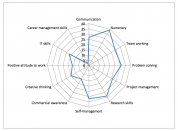
Radar Graph from Audit
9 students were involved in conducting the audit, drawn from across first to fourth year studies. Initially, a review was carried out of the modules students were currently studying in their year. Data was collected for each year and at a module level; each module, in each year, was scored out of 10 for how well it covered the 12 employability skills set used by the originating University of Exeter project. The scores from each module were then combined to give an overall rating for each skill for that particular year.
These results were then used to create a series of radar charts. These radar charts visually show the level of skills represented in each year and those skills which are adequately included or under-represented can be identified readily.
Students captured their experience through the audit process using an online blog.
The students' work resulted in an Civil Engineering Employability Audit Report describing the project’s rationale and findings and that includes, on pages 17 - 22, a case study of Birmingham's experience of, and learning from, the project:
Birmingham - Employability Audit Report & Case Study
A key finding outlined in the report is that, for all year groups, more of a focus on career management and commercial awareness is needed. In the first year, an additional lecture on career management could be added to the Design and Professional Skills A module. This is a module that currently provides the skills that are needed when entering the professional world of Engineering and would be a suitable place to meet this need.
However, this skill needs to be carried through the rest of the degree programme, building on basics taught in first year. As such, additional lectures, that are compulsory, need to be included in each year. Though there is support available to students through the careers service, there is no guarantee that this will be used by all students. Experience has shown a reluctance to attend career-focused lectures and thus the importance of these lectures needs to be shown to students.
Crucially, the findings from the audit will:
1. Feed into the module review process currently being undertaken in the School of Civil Engineering
2. Feed into the programme review of the School with the view to considering the balance between the various employability skills and its distribution throughout the curriculum, as well as the involvement of visiting lecturers in the school
3. Be of interest to the School's Industrial Board, as it provides industrial comment and input into the curriculum

Dr Barrie Cooper
Project lead, University of Exeter

Abel Nyamapfene
University of Exeter
Amanda Arthur
University of Exeter
Amy Boylan
University of Exeter
Chloe Cunningham
University of Exeter

Dawn Evans
University of Exeter
Fiona Dyke
Teach First
Greg Craft
Nationwide
Holly Geipel
University of Exeter
James Baxani
Teach First
Jodie Sherman
JP Morgan
Julie Hawkings
Centrax
Kathryn Edwards
Airbus
Lee Stott
Microsoft
Mohit Malik
RBS
Paul Hartley
Devon Education Business Partnership
Richard Whinnett
University of Exeter
Rowanna Smith
University of Exeter

 Developing Writing in STEM Disciplines
 Get STEM working: innovation with employer and student engagement
 Online Numeracy Resource & Nursing
 Progressing from labour market intelligence to HE level provision that is well supported by employers
 Community of Practice for Outreach and WP Practitioners
 The challenges and opportunities of incorporating community-based learning into STEM subjects
 Student-led Employability Audit Toolkit
 Learning chemistry through placements: building on good practice and identifying new opportunities
 Transition & Induction Experiences of WP Students
 Adult returner journeys through HE to STEM careers
 Visual Impairment & STEM
 The integration of understanding of offerings for engagement between universities and industry
 Employer engagement continuum model
 Enhancing Workplace Statistical Literacy
 Projects without borders: Understanding how employer-led UG projects differ across the STEM disciplines
 Technology-enabled employer engagement in analytical chemistry
 Quantifying the benefits to collaborating companies of working with groups of students on UG projects
 South West HE STEM Workforce Development & Employability Conference
 Developing a new CRM system for managing relationships with SMEs
 Better understanding drivers for employer engagement through an innovative approach to relationship management
 Developing & Enhancing STEM Communicator Models
 Mechanisms for sustainable employer engagement
 Peer Assisted Learning & STEM
 The Hydrographic Academy: Meeting the needs of the workforce and industry through innovative, flexible, online distance learning
 Enhancing STEM Academics' Public Engagement Skills


© University of Bath 2011-12
HE STEM Programme, University of Bath, Bath, BA2 7AY, UK
Updated by HE STEM web team
Website by Float
