
Lead Institution: University of Bath
Collaborating with: University of Exeter, Plymouth University
This National HE STEM Programme project aimed to develop a problem-based activity for second year Chemistry undergraduates to enable them to develop key transferable skills, building on good practice from a model developed by the Institute of Physics (IOP), called The Ashfield Music Festival. Ashfield used the context of a music festival to allow A-level students to explore simple physics and transferable skills, such as budgeting and teamwork. This contextual style of teaching is called Context and Problem Based Learning, or CPBL.
The activity developed through this project used the CPBL-style to task students with designing and running their own simulated fireworks display, through which they developed skills such as teamworking, verbal and written communication, budgeting and the assessment of risk. The activity was designed in collaboration with industrial partners working in pyrotechnics display and manufacturing companies.
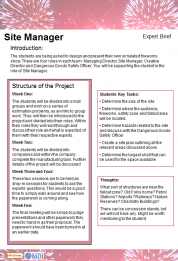
Example of a CPBL Resource
Several reports have identified that graduates from STEM disciplines feel there is a lack of opportunity to develop transferable skills during their degree. This deficit was highlighted in an Royal Society of Chemistry report, The Chemical Skills Pipeline, which recommended that universities should embed training in transferable skills, ideally using CPBL. Students can show a reluctance to engage with skills training as it is often seen as low priority during their degree; it is felt that CPBL can be a good way of making training relevant. However, finding discipline-specific contexts can be difficult. Although a bank of CPBL problems is being developed by various higher education institutions, skills sometimes lacking are those of commercial awareness, enterprise and leadership.
This project added value by providing a discipline-appropriate context through which Chemistry students could explore these skills through a fun and challenging problem. Collaboration with industrial partners helped make the task relevant to the needs of employers and highlighted employability skills to students. In addition, the use of PhD students as facilitators during the task gives them the opportunity to develop communication skills and to gain experience of teaching in HE.
The report below outlines the design process, implementation and trialling of the resources created and the evaluation data gained, including feedback from undergraduates, postgraduates and staff involved in the project. A discussion of the lessons learnt is also included to help transfer the project to other institutions. The resources from this project are readily transferable to other chemistry departments, and to other STEM disciplines with minimal alteration.
The final report for the project can be downloaded below:
1. Industrial input – Working with industry was essential. The information provided by Glenn Plume from Alchemy Fireworks and Matthew Tosh from Skyburst the Firework Company, helped guide research. Without the inside information provided by these companies, the project would not have been as realistic. Students also commented on the value of industrial input, making the task more “real world” and engaging.
2. Introducing Context and Problem Based Learning to the department – Staff from the Department of Chemistry at the University of Bath have been very impressed with the project and it has catalysed an interest in embedding more CPBL approaches into the curriculum.
3. Feedback and effort from students – This was a non-credit bearing activity and everyone involved with the project was impressed at the significant level of effort put in by students completing the activity. Feedback from students showed that they felt the activity was fun but also helped them to develop key transferable skills and to receive formative feedback on areas such as oral and written communication, areas summatively assessed as part of the third year.

Dr Gan Shermer
Project lead, University of Bath
Emily M MacCready
Project coordinator, University of Bath
Nicola King
University of Exeter
Roy Lowry
Plymouth University

 Get STEM working: innovation with employer and student engagement
 Developing a new CRM system for managing relationships with SMEs
 Progressing from labour market intelligence to HE level provision that is well supported by employers
 The challenges and opportunities of incorporating community-based learning into STEM subjects
 Projects without borders: Understanding how employer-led UG projects differ across the STEM disciplines
 Peer Assisted Learning & STEM
 Becoming a STEM Enthusiast - Outreach & CPD Video Resources
 Strengthening, extending and embedding employer engagement
 Student-led Employability Audit Toolkit
 The integration of understanding of offerings for engagement between universities and industry
 Adult returner journeys through HE to STEM careers
 Employability Skills of STEM Student Ambassadors
 Online Numeracy Resource & Nursing
 Extending the Use of Spectroscopy in a Suitcase
 Enhancing STEM Academics' Public Engagement Skills
 Access Grid Nodes for remote training provision for work-based learners
 Technology-enabled employer engagement in analytical chemistry
 Developing Writing in STEM Disciplines
 The Hydrographic Academy: Meeting the needs of the workforce and industry through innovative, flexible, online distance learning
 A study of the key drivers in workforce engagement with HE level provision in the Aerospace sector
 HiSPARC - Doing Real Particle Physics Research in Schools
 Community of Practice for Outreach and WP Practitioners
 Enhancing Workplace Statistical Literacy
 The employer perspective on universities' promotion of opportunities to engage with the STEM UG curriculum
 Promoting employer engagement opportunities to employers


© University of Bath 2011-12
HE STEM Programme, University of Bath, Bath, BA2 7AY, UK
Updated by HE STEM web team
Website by Float
