
Lead Institution: University of Exeter
Collaborating with: Bournemouth University
This is a sub-project of Get STEM working: innovation with employer and student engagement
As part of our review of current standards of employer engagement within projects at the University of Exeter, we distributed a questionnaire to MEng students who had participated in a 3rd year project with an element of industrial involvement.
The aim of this was to gain a deeper understanding of the students’ experiences during the projects, and to identify areas of success and concern. We chose engineering students as the pilot group for this study as these projects already had an “industrial rating” relating to how involved with industry they were, and there were reports of a number of highly successful industry-led projects that had taken place.
Ten MEng students reported that they had undertaken a project involving industrial collaboration, and 8 of these students fully answered the questionnaire. As this is a small sample, in order to gain depth of knowledge we plan to interview these students to obtain a more qualitative and personal review of their experiences. We have also set up a number of interviews with those project supervisors whose activities have had the greatest levels of industrial involvement. The survey wording is directed towards both students and project supervisors in order to facilitate comparisons. The initial results are summarised below, in the same categories as presented in the questionnaire:
Section 1 - Relationship between the Industrial Partner and You
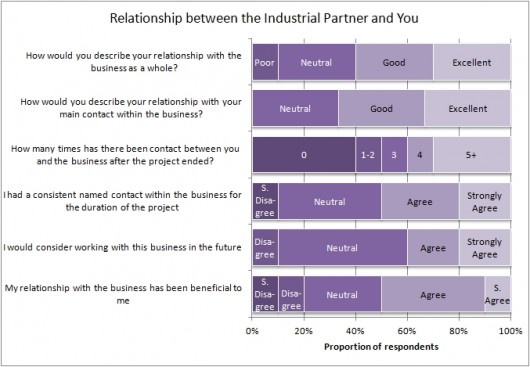
Graph showing students' answers to questions relating to their relationship with the business involved in their project.
Section 2 - Student Benefit
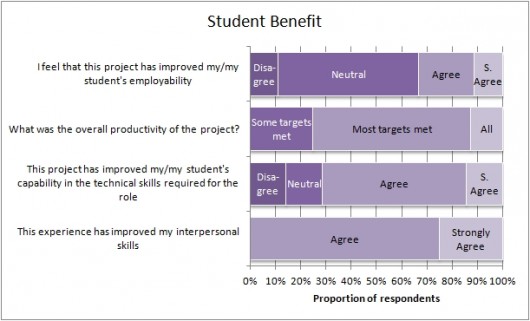
Graph showing students' answers to questions relating to how they potentially benefited from taking part in the project.
Section 3 - Project Successes
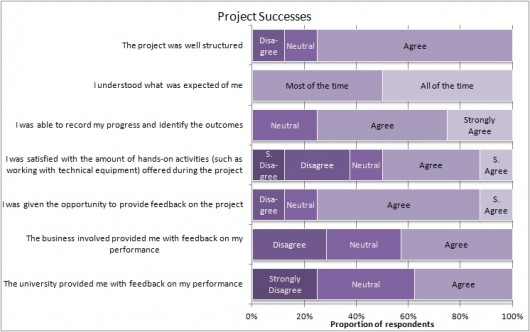
Graph showing students' answers to questions relating to possible successes that may have occurred during the project.
Section 4 - Project Challenges
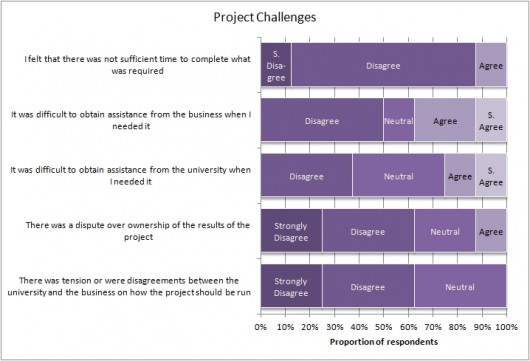
Graph showing students' answers to questions relating to potential challenges within the project.
Section 5 - Implementing the Project
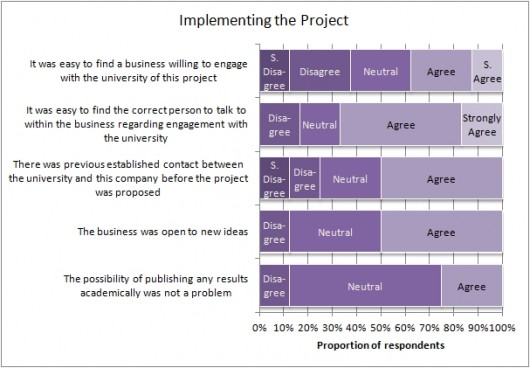
Graph showing students' answers to questions relating to factors influencing the implementing the project.
Section 6 - Dissemination
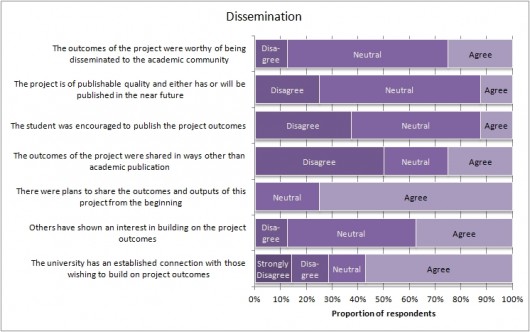
Graph showing students' answers to questions relating to how the project outputs and outcomes were shared.
Summary, Conclusions and Future Actions
On many of the questions a significant proportion of the students gave an inconclusive answer - this strengthens our original plan to individually interview the students who responded, as we can also now investigate further why these students answered neutrally, along with our intentions to unveil a qualitative picture.
Relationship - a minority of students report a negative experience regarding their relationship with the partner business, but a larger proportion report positively. We intend to uncover the reasons for both the positive and negative reviews in further interviews.
Student Benefit - a large portion of students were unsure how their project affected their employability - it would be interesting to discover why, whether it is a lack of knowledge regarding employability, or that they were unsure of the impact of their work. However, the majority of the students felt that they had increased both their technical and interpersonal skills, as well as rating the project as productive - further investigation may reveal why the minority did not agree with this.
Project Successes - one fantastic result here is that all the respondents felt that they understood what was expected of them at least most of the time within the project, indicating clear communication between project leaders and their students. The graph also identifies that students felt that feedback from the businesses involved was more apparent than university feedback - though not by much. This is a finding that could be incorporated into future project design.
Project Challenges - It appears that the main challenge students faced was obtaining assistance from the businesses when they needed it. This could potentially be remedied by ensuring that in all future projects the businesses are encouraged by the university to interact more with the students.
Implementing the Project - A large chunk of students responded neutrally to the question regarding publication - in the interviews we intend to ascertain whether this is because they are not sure what the requirements are for publication, or if they simply weren't aware that publication was a possibility. The question relating to how easy it is to engage businesses had a widely varied response - it would be useful to match individual experiences with these ratings to gain a deeper knowledge.
Dissemination - again, questions relating to publication score highly on neutral answers. However, there is a positive response to "There were plans to share the outcomes and outputs of this project from the beginning" showing that dissemination is integrated firmly into the design of these projects.

Dr Barrie Cooper
Project lead, University of Exeter

Abel Nyamapfene
Project coordinator, University of Exeter
Chloe Cunningham
University of Exeter

Christine Keenan
Bournemouth University

Dawn Evans
University of Exeter

Penny Mitchell
Bournemouth University

 Developing Writing in STEM Disciplines
 Progressing from labour market intelligence to HE level provision that is well supported by employers
 Get STEM working: innovation with employer and student engagement
 The Hydrographic Academy: Meeting the needs of the workforce and industry through innovative, flexible, online distance learning
 Employer engagement continuum model
 Projects without borders: Understanding how employer-led UG projects differ across the STEM disciplines
 Development and implementation of a programme of employability skills for Science undergraduates
 Strengthening, extending and embedding employer engagement
 Peer Assisted Learning & STEM
 The integration of understanding of offerings for engagement between universities and industry
 Visual Impairment & STEM
 Employability Skills of STEM Student Ambassadors
 Student-led Employability Audit Toolkit
 Adult returner journeys through HE to STEM careers
 Transition & Induction Experiences of WP Students
 The employer perspective on universities' promotion of opportunities to engage with the STEM UG curriculum
 Learning chemistry through placements: building on good practice and identifying new opportunities
 Enhancing STEM Academics' Public Engagement Skills
 The challenges and opportunities of incorporating community-based learning into STEM subjects
 Promoting employer engagement opportunities to employers
 Online Numeracy Resource & Nursing
 Developing & Enhancing STEM Communicator Models
 A study of the key drivers in workforce engagement with HE level provision in the Aerospace sector
 HiSPARC - Doing Real Particle Physics Research in Schools
 Quantifying the benefits to collaborating companies of working with groups of students on UG projects


© University of Bath 2011-12
HE STEM Programme, University of Bath, Bath, BA2 7AY, UK
Updated by HE STEM web team
Website by Float
